TB-500 vs GHK-Cu
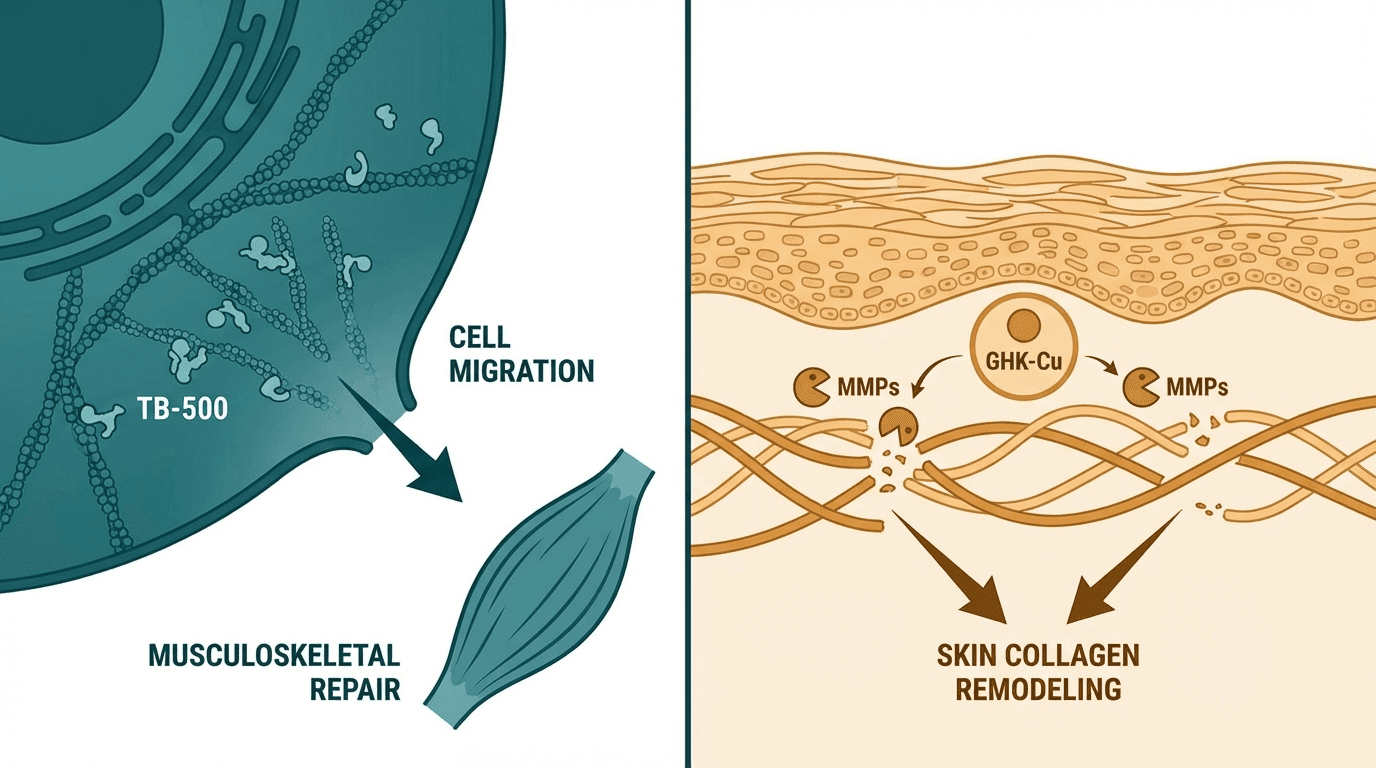
TB-500 (a fragment of thymosin beta-4) and GHK-Cu are both regenerative peptides with distinct healing profiles. TB-500 provides systemic healing by upregulating actin, promoting cell migration, and reducing inflammation in deep tissues including cardiac muscle, joints, and connective tissue. GHK-Cu is a copper-chelated tripeptide that drives extracellular matrix remodeling, collagen synthesis, and anti-inflammatory gene expression, making it the go-to peptide for skin rejuvenation, wound healing, and hair restoration.
Head-to-Head Comparison
| Criteria | TB-500 | GHK-Cu |
|---|---|---|
| Primary mechanism | Actin upregulation, cell migration promotion, angiogenesis | Copper-dependent collagen/elastin synthesis, matrix metalloproteinase modulation |
| Healing scope | Systemic — heals deep tissue, cardiac, joints, and muscles | Surface-oriented — skin, superficial wounds, hair follicles, bone |
| Route of administration | Subcutaneous or intramuscular injection only | Topical (cream/serum), subcutaneous, or intradermal |
| Typical dosage | 2.0–2.5 mg, 2x per week | 1–2 mg daily (injectable); 1–4% cream (topical) |
| Half-life | ~6–8 hours (systemic activity lasts longer) | ~30 minutes in plasma (copper complex extends tissue activity) |
| Cardiac repair potential | Strong — promotes cardiac cell survival and regeneration post-injury | Minimal — not studied for cardiac applications |
| Skin and cosmetic benefits | Indirect — may improve skin healing systemically | Excellent — direct collagen I/III stimulation, elastin production, antioxidant |
| Hair growth evidence | Preliminary — stem cell activation in follicles | Moderate — increases follicle size, Wnt signaling, and hair thickness |
| Anti-inflammatory action | Systemic — reduces inflammatory markers throughout the body | Local/gene-level — modulates TGF-beta, TNF-alpha, IL-6 expression |
| Flexibility and joint support | Yes — commonly reported improvement in joint flexibility | Limited — not a primary use case |
| WADA status | Banned — listed in and out of competition | Not currently listed as prohibited |
| Approximate monthly cost | $60–$120 | $30–$60 (topical); $50–$100 (injectable) |
When to Choose Each
Verdict
TB-500 is the better choice for deep, systemic healing — particularly cardiac repair, widespread inflammation, joint recovery, and hard-to-reach injuries — due to its actin-mediated cell migration and systemic reach. GHK-Cu is superior for anything surface-level: skin anti-aging, wound closure, scar reduction, and hair restoration through its direct collagen-boosting mechanism. Athletes recovering from injuries may prefer TB-500, while those focused on cosmetic or dermatological outcomes should choose GHK-Cu.
References
- Thymosin beta-4 promotes angiogenesis, wound healing, and hair follicle development (2006) — PubMed
- GHK peptide as a natural modulator of multiple cellular pathways in skin regeneration (2015) — PubMed
- Thymosin beta-4 activates integrin-linked kinase and promotes cardiac cell migration, survival, and cardiac repair (2004) — PubMed
- The human tripeptide GHK-Cu in prevention of oxidative stress and degenerative conditions of aging (2012) — PubMed
- Actin sequestering protein thymosin beta-4 in inflammation and tissue remodeling (2016) — PubMed
Frequently Asked Questions
Can TB-500 and GHK-Cu be stacked together?
Which is better for sports injuries?
Why is TB-500 banned by WADA but GHK-Cu is not?
Is GHK-Cu effective when applied topically or does it need to be injected?
How long does it take to see results from TB-500 vs GHK-Cu?
Explore next
- TB-500 dosage guideEducational reference covering TB-500 (Thymosin Beta-4) dosage protocols, including loading and maintenance phases, reconstitution, and administration details as discussed in research literature.
- GHK-Cu dosage guideEducational reference for GHK-Cu (copper peptide) dosage protocols including subcutaneous injection, topical application, and microneedling as discussed in published research.