Follistatin vs IGF-1 LR3
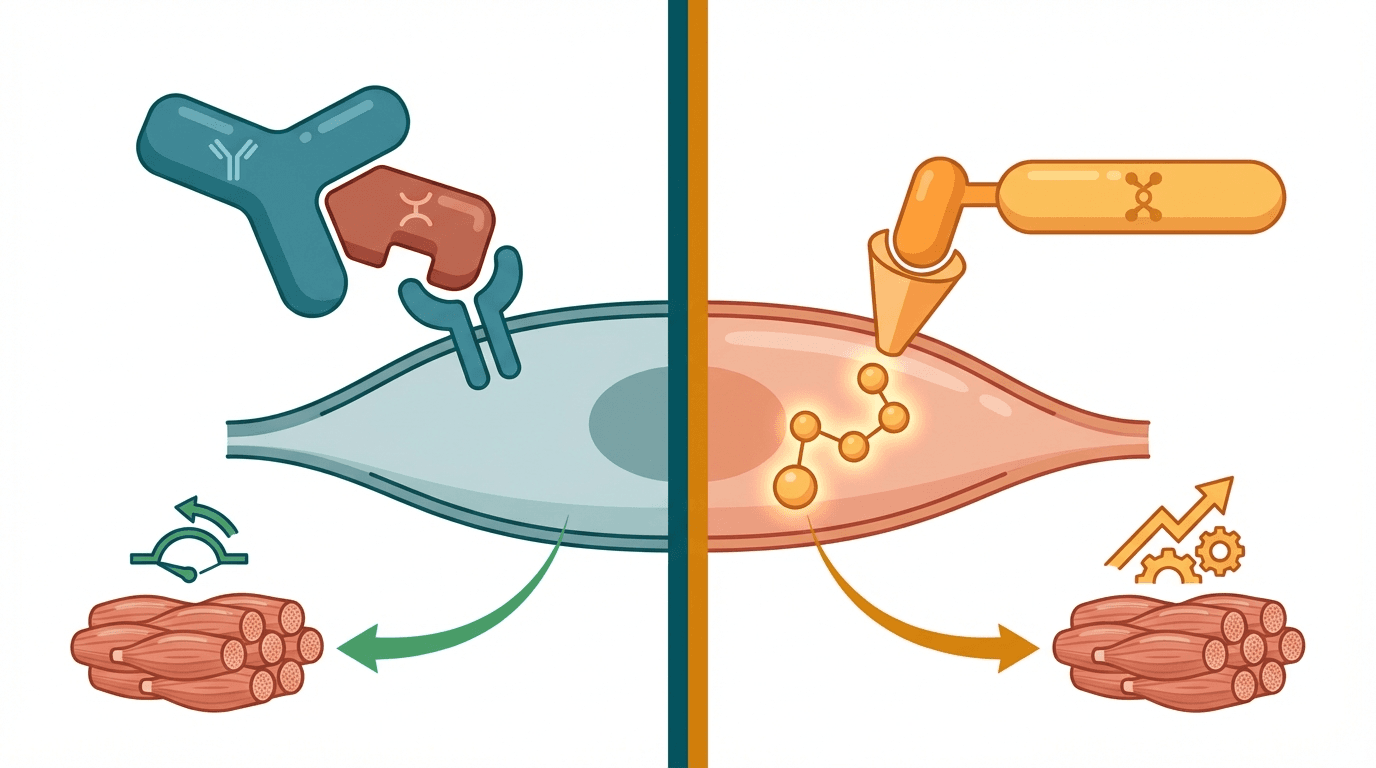
Follistatin and IGF-1 LR3 both promote muscle growth but through opposite strategies. Follistatin is a naturally occurring glycoprotein that binds and inhibits myostatin and activin — effectively removing the molecular brakes on muscle growth. IGF-1 LR3 is a modified insulin-like growth factor that directly stimulates muscle protein synthesis and hyperplasia by activating the IGF-1 receptor (pressing the accelerator). Follistatin is a large protein (~36 kDa) that is extremely expensive and difficult to produce, with very limited availability, while IGF-1 LR3 is more accessible. Both remain largely preclinical for muscle-building applications in humans.
Head-to-Head Comparison
| Criteria | Follistatin | IGF-1 LR3 |
|---|---|---|
| Primary mechanism | Inhibits myostatin and activin (removes negative regulators of muscle growth) | Directly activates IGF-1 receptor (stimulates muscle protein synthesis and hyperplasia) |
| Approach to muscle growth | Removes the brake — blocks signals that limit muscle mass | Presses the accelerator — directly drives anabolic signaling |
| Molecular size | Large glycoprotein (~36 kDa, 288–315 amino acids depending on isoform) | Modified peptide (~9.1 kDa, 83 amino acids) |
| Route of administration | Subcutaneous injection (poor oral bioavailability due to size) | Intramuscular or subcutaneous injection |
| Typical dosage | 100–200 mcg/day (protocols vary widely; limited standardization) | 20–80 mcg/day, split into 1–2 injections |
| Half-life | Variable by isoform — FS344 has shorter half-life, FS315 is more stable | 20–30 hours (extended by LR3 modification) |
| Effect on myostatin | Directly binds and neutralizes myostatin — primary mechanism of action | No direct effect on myostatin signaling |
| Hypoglycemia risk | Minimal — does not directly affect glucose/insulin signaling | Significant — directly lowers blood glucose via insulin-like activity |
| Animal evidence for muscle growth | Strong — myostatin knockout and follistatin overexpression produce dramatic muscle hypertrophy in mice (2–3× normal muscle mass) | Strong — IGF-1 LR3 infusion produces significant muscle hypertrophy in rodents independent of load |
| Availability | Very limited — expensive to manufacture, few reliable sources, quality concerns | Moderately available from research peptide suppliers |
| Approximate monthly cost | $300–$1,000+ (if authentic product can be sourced) | $100–$250 (research grade) |
| Research status | Preclinical for muscle; AAV-follistatin gene therapy in Phase 1/2 for muscular dystrophy | Preclinical for muscle; clinical research for IGF-1 deficiency conditions |
When to Choose Each
Choose Follistatin
Research interest in myostatin inhibition, muscular dystrophy (gene therapy context), users willing to pay premium for theoretical myostatin blockade, those concerned about hypoglycemia from IGF-1
Choose IGF-1 LR3
Direct anabolic stimulation for muscle growth, users wanting more established dosing protocols, more cost-effective muscle peptide option, those seeking hyperplasia (new muscle cells) rather than just hypertrophy
Verdict
For most users interested in muscle growth, IGF-1 LR3 is the more practical choice — it is more available, better characterized in dosing, and has a clearer mechanism for direct anabolic stimulation. Follistatin is theoretically compelling because myostatin inhibition can produce dramatic muscle growth in animal models, but the injectable peptide form is extremely expensive, difficult to authenticate, and lacks established human dosing protocols. The most promising follistatin application is in gene therapy for muscular dystrophies, where AAV-delivered follistatin has shown encouraging early clinical results. Neither should be considered a casual supplement — both carry significant unknowns for long-term human use.
References
- Follistatin gene delivery enhances muscle growth and strength in nonhuman primates (2009) — PubMed
- AAV1.follistatin gene therapy for inclusion body myositis: Phase 1 trial results (2017) — PubMed
- Myostatin inhibition in muscle — a new frontier for the treatment of cachexia and muscle wasting (2013) — PubMed
- Insulin-like growth factor-I LR3 promotes skeletal muscle hypertrophy independent of load (2010) — PubMed
- Regulation of muscle growth by multiple ligands signaling through activin type II receptors (2005) — PubMed
Frequently Asked Questions
Can follistatin and IGF-1 LR3 be stacked?
Is most follistatin sold online actually real?
What is the difference between FS344 and FS315 follistatin?
How does follistatin gene therapy differ from injectable follistatin?
Are there safer alternatives to follistatin and IGF-1 LR3 for muscle growth?
Explore next
- Reconstitution CalculatorCalculate exactly how many units to draw on your syringe. Enter your vial size, bacteriostatic water volume, and desired dose.
- Dosage CalculatorFind evidence-based dosing ranges for any peptide. Adjust for body weight, experience level, and administration route.
- Cost CalculatorEstimate peptide costs per dose, per week, per month, and per year. Enter your vial price and dosing schedule to plan your budget.