CJC-1295 vs Ipamorelin
CJC-1295 and ipamorelin are the most frequently combined growth hormone peptides, but they work through fundamentally different pathways. CJC-1295 is a modified GHRH analog that stimulates the GHRH receptor on pituitary somatotrophs to increase baseline GH output, while ipamorelin is a selective GHRP that mimics ghrelin to trigger acute GH pulses. Together they produce a powerful synergistic effect — the GHRH + GHRP combination can amplify GH release 3–5× compared to either peptide used alone.
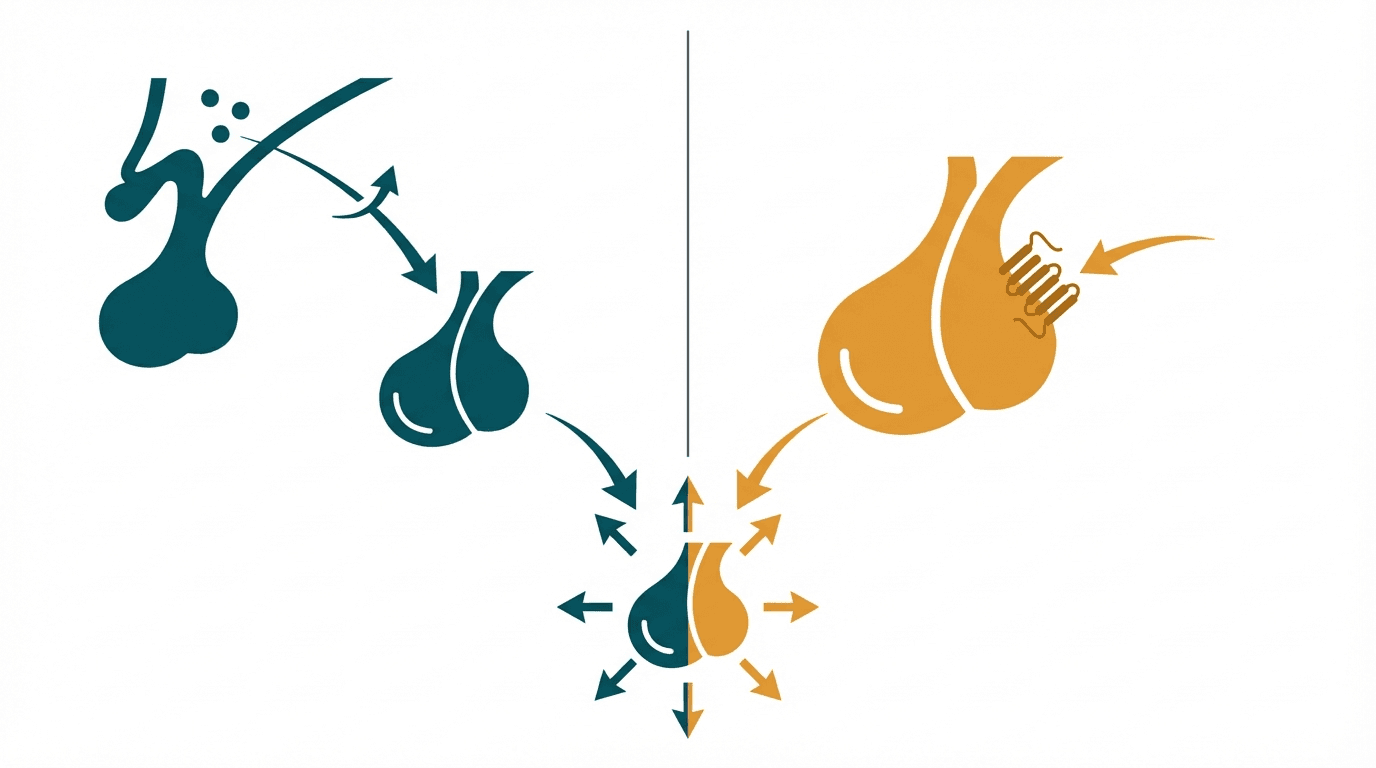
Head-to-Head Comparison
| Criteria | CJC-1295 | Ipamorelin |
|---|---|---|
| Primary mechanism | GHRH receptor agonist — stimulates GH synthesis and secretion at the pituitary | Ghrelin receptor (GHS-R1a) agonist — triggers pulsatile GH release |
| Peptide class | Growth hormone releasing hormone (GHRH) analog | Growth hormone releasing peptide (GHRP) |
| Half-life | ~30 minutes (no DAC); ~8 days (with DAC modification) | ~2 hours |
| Typical dosage | 100 mcg (no DAC) 1–3× daily; or 2 mg (with DAC) 1–2× weekly | 200–300 mcg subcutaneous, 1–3× daily |
| GH release pattern | Elevated baseline GH with sustained release (especially CJC-1295 DAC) | Sharp, pulsatile GH spikes mimicking natural secretion rhythm |
| Cortisol/prolactin impact | Minimal increase in cortisol; no significant prolactin elevation | Highly selective — virtually no cortisol or prolactin elevation |
| Appetite effect | No significant appetite stimulation | Minimal appetite increase despite ghrelin mimicry |
| Synergy | Synergistic when combined with GHRPs (ipamorelin, GHRP-2, GHRP-6) | Synergistic when combined with GHRH analogs (CJC-1295, sermorelin) |
| DAC variant | Yes — Drug Affinity Complex version extends half-life to ~8 days, allowing weekly dosing | No DAC variant exists |
| IGF-1 elevation | Significant sustained IGF-1 increase (especially with DAC) | Moderate transient IGF-1 elevation post-injection |
| Side effects | Injection site irritation, water retention, facial flushing, tingling/numbness | Very mild — occasional headache, transient flushing |
| Approximate monthly cost | $50–$100 (research grade); $200–$450 (clinic) | $40–$80 (research grade); $150–$350 (clinic) |
When to Choose Each
Choose CJC-1295
Users who want sustained GH/IGF-1 elevation with less frequent dosing, those prioritizing body recomposition and anti-aging, protocols where consistent baseline GH is more important than pulsatile release
Choose Ipamorelin
Beginners seeking the cleanest GH peptide with fewest side effects, athletes wanting pulsatile GH release for recovery, users who prefer daily dosing with natural GH rhythm
Verdict
CJC-1295 and ipamorelin are not competitors — they are the gold-standard GH peptide stack. CJC-1295 provides the sustained GHRH signal that keeps GH output elevated throughout the day, while ipamorelin delivers clean, pulsatile GH spikes that mimic youthful secretion patterns. Used together, they exploit the well-documented GHRH/GHRP synergy to maximize GH and IGF-1 without the side effects of exogenous HGH. If forced to choose only one, ipamorelin is better for beginners due to its cleaner side effect profile, while CJC-1295 with DAC is better for those wanting convenience (less frequent dosing) and sustained IGF-1 elevation.
References
- Prolonged stimulation of growth hormone (GH) and insulin-like growth factor I secretion by CJC-1295, a long-acting analog of GH-releasing hormone, in healthy adults (2006) — PubMed
- Ipamorelin, the first selective growth hormone secretagogue (1998) — PubMed
- Synergistic effects of GHRP and GHRH on GH release in vivo and in vitro (1996) — PubMed
- The effect of CJC-1295, a synthetic GHRH analog, on pulsatile GH secretion (2006) — PubMed
- Growth hormone secretagogues: history, mechanism of action, and clinical development (2000) — PubMed
Frequently Asked Questions
What is the difference between CJC-1295 with DAC and without DAC?
How should I dose the CJC-1295 + ipamorelin stack?
Is the CJC-1295 + ipamorelin combo as effective as HGH injections?
How long should I run the CJC-1295 + ipamorelin cycle?
Are CJC-1295 and ipamorelin legal to buy?
Explore next
- CJC-1295 dosage guideEducational reference for CJC-1295 dosage protocols with and without Drug Affinity Complex (DAC). Covers modified GRF 1-29, CJC-1295 DAC, and combination stacking approaches discussed in research literature.
- Ipamorelin dosage guideEducational reference for ipamorelin dosage protocols, optimal timing, and administration guidelines as discussed in published research studies.