Tools
Half-Life Calculator
Enter a starting amount, half-life, and elapsed time to calculate how much remains. Includes a decay timeline and the exact exponential formula.
Remaining after 12 hours
0.2500
mg (25.0% remaining)
% remaining
25.0
%
% decayed
75.0
%
Half-lives elapsed
2.00
× 6 h
Show the math›
Formula: A(t) = A₀ × (½)^(t / t½)
A(12) = 1 × (0.5)^(12 / 6)
= 1 × (0.5)^2.0000
= 1 × 0.250000
= 0.250000 mg
Percentage: (0.250000 / 1) × 100 = 25.00%
Assumptions
- Assumes simple first-order (exponential) decay
- Real pharmacokinetics involve absorption, distribution, and metabolism phases that this model does not capture
- Half-life values vary between individuals based on metabolism, body composition, and administration route
- This is a mathematical model, not a pharmacokinetic simulation
How This Calculator Works
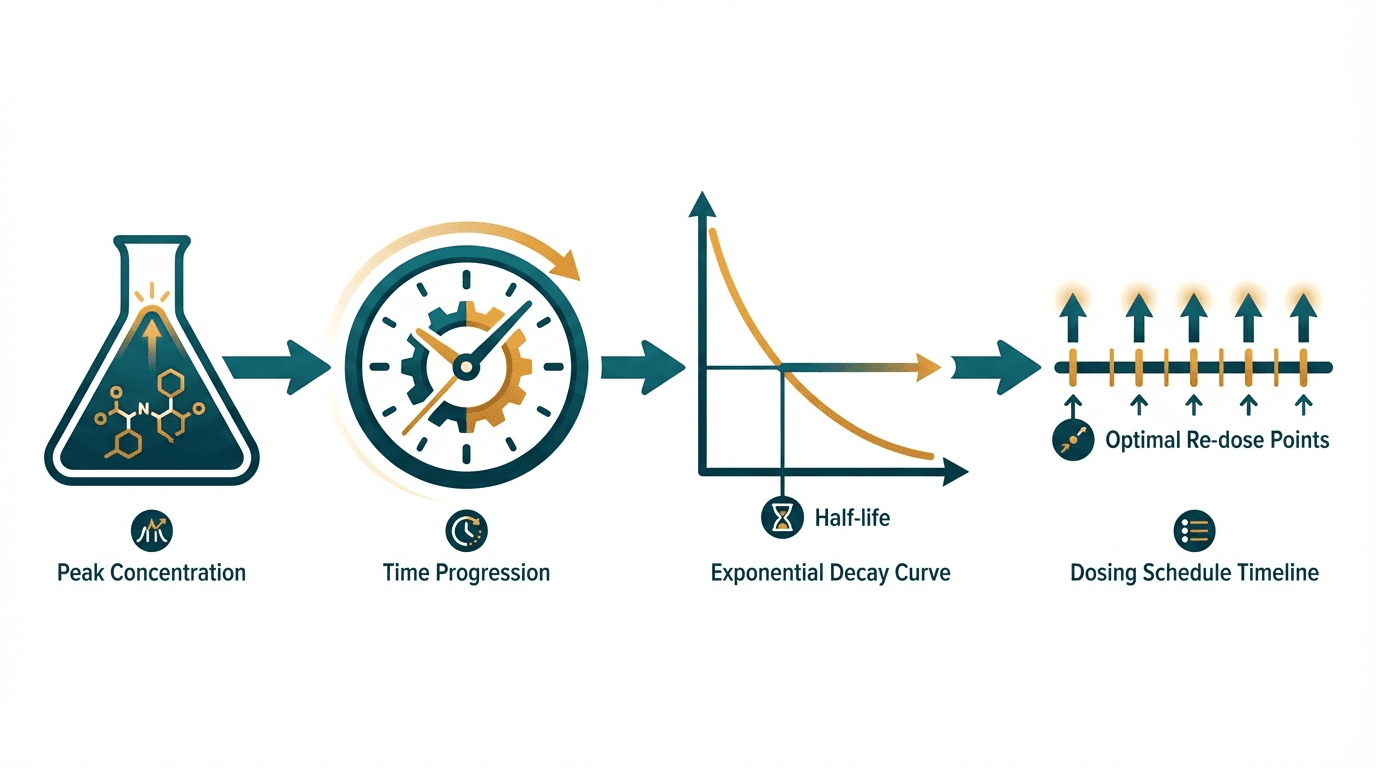
The calculator uses the exponential decay formula: A(t) = A₀ × (½)^(t / t½), where A₀ is the starting amount, t is elapsed time, and t½ is the half-life. The decay timeline shows remaining amounts at each half-life interval.
Assumptions & Limitations
- Assumes simple first-order exponential decay — real pharmacokinetics are more complex.
- Does not model absorption, distribution, or multi-compartment elimination.
- Half-life values vary by individual, administration route, and formulation.
- This is a mathematical model for estimation, not a clinical pharmacokinetic simulation.
Explore next
- Reconstitution CalculatorCalculate exactly how many units to draw on your syringe. Enter your vial size, bacteriostatic water volume, and desired dose.
- Dosage CalculatorFind evidence-based dosing ranges for any peptide. Adjust for body weight, experience level, and administration route.
- Cost CalculatorEstimate peptide costs per dose, per week, per month, and per year. Enter your vial price and dosing schedule to plan your budget.
- Injection Volume CalculatorConvert any peptide dose to exact mL and syringe units. Enter your desired dose and concentration to see exactly how much to draw on a U-100 insulin syringe.
Frequently Asked Questions
What is a half-life?
How is this different from real pharmacokinetics?
Where do I find the half-life for a specific peptide?
Can I use any time unit?
Educational Use Only
This calculator models simple exponential decay for educational purposes. It is not a pharmacokinetic simulation and should not be used for clinical dosing decisions. Consult a healthcare provider for guidance on drug metabolism and timing.
Last reviewed: February 2026