Best Peptides for Longevity & Cellular Health (2026 Guide)
A comprehensive guide to the best peptides for longevity, anti-aging at the cellular level, and healthspan extension. Covers Epithalon, SS-31, MOTS-c, Humanin, and NAD+ with evidence ratings, mechanisms targeting telomeres, mitochondria, and senescence.
Overview
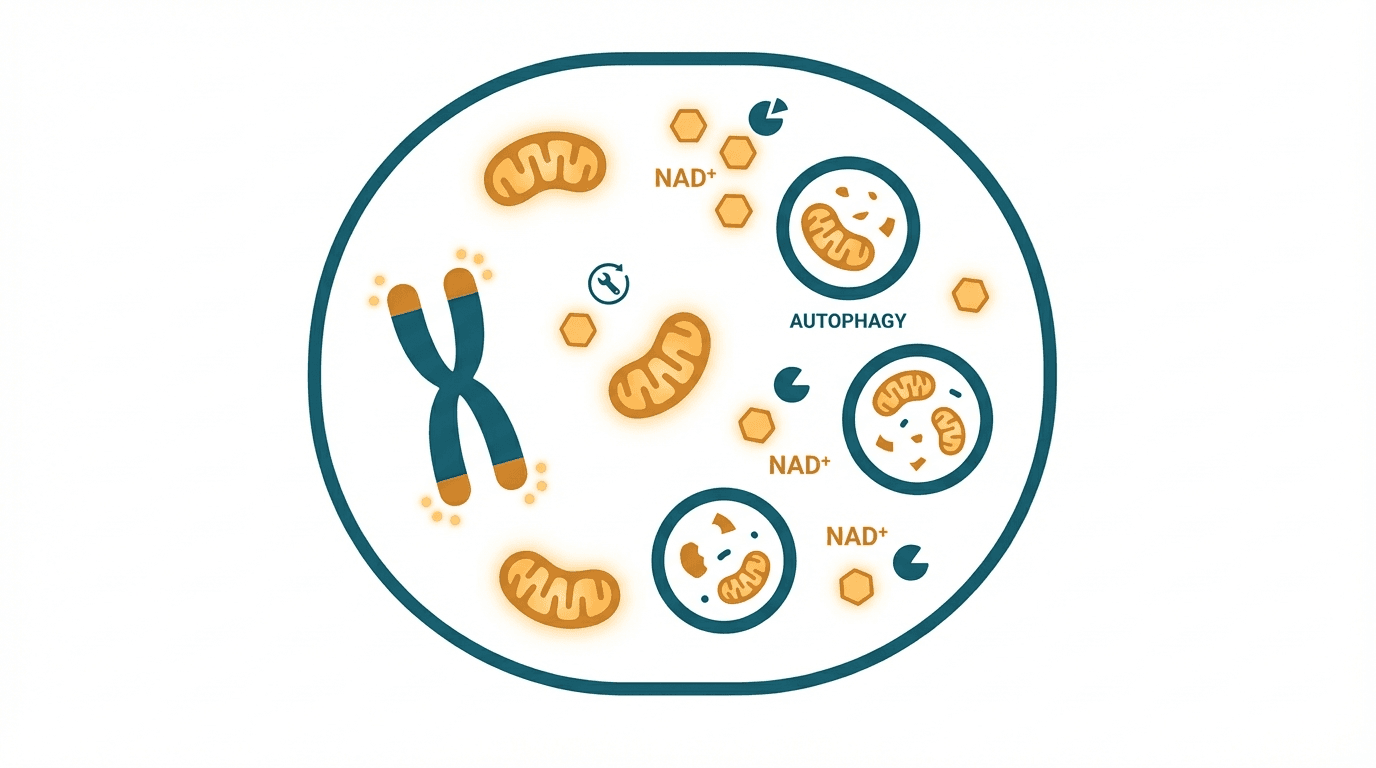
The science of longevity has moved beyond caloric restriction and antioxidants toward targeting the fundamental hallmarks of aging: telomere attrition, mitochondrial dysfunction, cellular senescence, and metabolic decline. Peptides are uniquely positioned in this space because they can precisely target these mechanisms with high specificity and low toxicity. Epithalon, a synthetic tetrapeptide based on the pineal gland's epithalamin, is the only known pharmacological telomerase activator with in vivo human data. Mitochondria-derived peptides (MDPs) like MOTS-c and Humanin represent an entirely new class of endogenous signaling molecules that protect against age-related metabolic and cellular decline. SS-31 (Elamipretide) targets cardiolipin in the inner mitochondrial membrane to restore electron transport chain efficiency, and NAD+ precursor strategies address the age-related decline in the coenzyme central to cellular energy metabolism and DNA repair.
Best Peptides for Longevity & Cellular Health
Mechanism: Activates telomerase (hTERT) in somatic cells, elongating telomeres and extending cellular replicative capacity; stimulates pineal melatonin production to restore circadian function; modulates antioxidant enzyme expression
Key benefit: Only known peptide telomerase activator with published human data showing telomere elongation in elderly subjects
Mechanism: Concentrates >1000-fold in mitochondria by binding cardiolipin in the inner membrane; stabilizes cytochrome c electron transport, reduces reactive oxygen species generation at the source, and restores ATP production in aged mitochondria
Key benefit: Directly rejuvenates mitochondrial function — the organelle whose decline drives much of biological aging
Mechanism: Mitochondria-derived peptide encoded in the 12S rRNA gene; activates AMPK signaling, enhances glucose uptake and fatty acid oxidation, regulates nuclear gene expression through retrograde signaling, and improves metabolic homeostasis under stress
Key benefit: Acts as a mitochondrial-encoded exercise mimetic that improves metabolic resilience and insulin sensitivity
Mechanism: Mitochondria-derived peptide that binds IGFBP-3 and BAX to inhibit apoptosis in stressed cells; activates STAT3 survival signaling; reduces amyloid-beta toxicity and oxidative damage; levels decline with age and correlate with longevity in centenarian studies
Key benefit: Cytoprotective peptide whose endogenous levels correlate with exceptional longevity in human centenarian populations
Mechanism: Essential coenzyme for sirtuin deacetylases (SIRT1-7), PARP DNA repair enzymes, and CD38/CD157 immune signaling; NAD+ levels decline ~50% between ages 40–60, compromising DNA repair capacity, mitochondrial biogenesis, and epigenetic maintenance
Key benefit: Restores the central metabolic coenzyme required for DNA repair, sirtuin activation, and mitochondrial function
Quick Comparison
| Peptide | Efficacy | Key Benefit | Profile |
|---|---|---|---|
| Epithalon | moderate | Only known peptide telomerase activator with published human data showing telomere elongation in elderly subjects | View → |
| SS-31 (Elamipretide) | emerging | Directly rejuvenates mitochondrial function — the organelle whose decline drives much of biological aging | View → |
| MOTS-c | emerging | Acts as a mitochondrial-encoded exercise mimetic that improves metabolic resilience and insulin sensitivity | View → |
| Humanin | emerging | Cytoprotective peptide whose endogenous levels correlate with exceptional longevity in human centenarian populations | View → |
| NAD+ | moderate | Restores the central metabolic coenzyme required for DNA repair, sirtuin activation, and mitochondrial function | View → |
References
- Peptide regulation of aging: 35-year research experience (2011) — PubMed
- Mitochondria-targeted peptide SS-31 (Elamipretide) prevents age-related decline in cardiac diastolic function (2018) — PubMed
- MOTS-c is an exercise-induced mitochondrial-encoded regulator of age-dependent physical decline and muscle homeostasis (2021) — PubMed
- Humanin is an endogenous activator of chaperone-mediated autophagy (2018) — PubMed
- Declining NAD+ induces a pseudohypoxic state disrupting nuclear-mitochondrial communication during aging (2013) — PubMed
- Epithalon peptide induces telomerase activity and telomere elongation in human somatic cells (2003) — PubMed
Frequently Asked Questions
What is the best peptide for anti-aging and longevity?
Does Epithalon really extend telomeres?
What are mitochondria-derived peptides (MDPs)?
Is NAD+ a peptide?
How long should a longevity peptide protocol last?
Explore next
- EpithalonOnly known peptide telomerase activator with published human data showing telomere elongation in elderly subjects
- SS-31 (Elamipretide)Directly rejuvenates mitochondrial function — the organelle whose decline drives much of biological aging
- MOTS-cActs as a mitochondrial-encoded exercise mimetic that improves metabolic resilience and insulin sensitivity
- HumaninCytoprotective peptide whose endogenous levels correlate with exceptional longevity in human centenarian populations
- Epithalon dosage guideEducational reference covering epithalon (epitalon) dosage protocols, cycling schedules, reconstitution instructions, and telomerase activation research. Dosing information discussed in published studies for informational purposes only.
- MOTS-c dosage guideEducational reference covering MOTS-c dosage protocols, metabolic support applications, reconstitution instructions, and AMPK activation research. Dosing information discussed in published studies for informational purposes only.