Sermorelin vs Tesamorelin
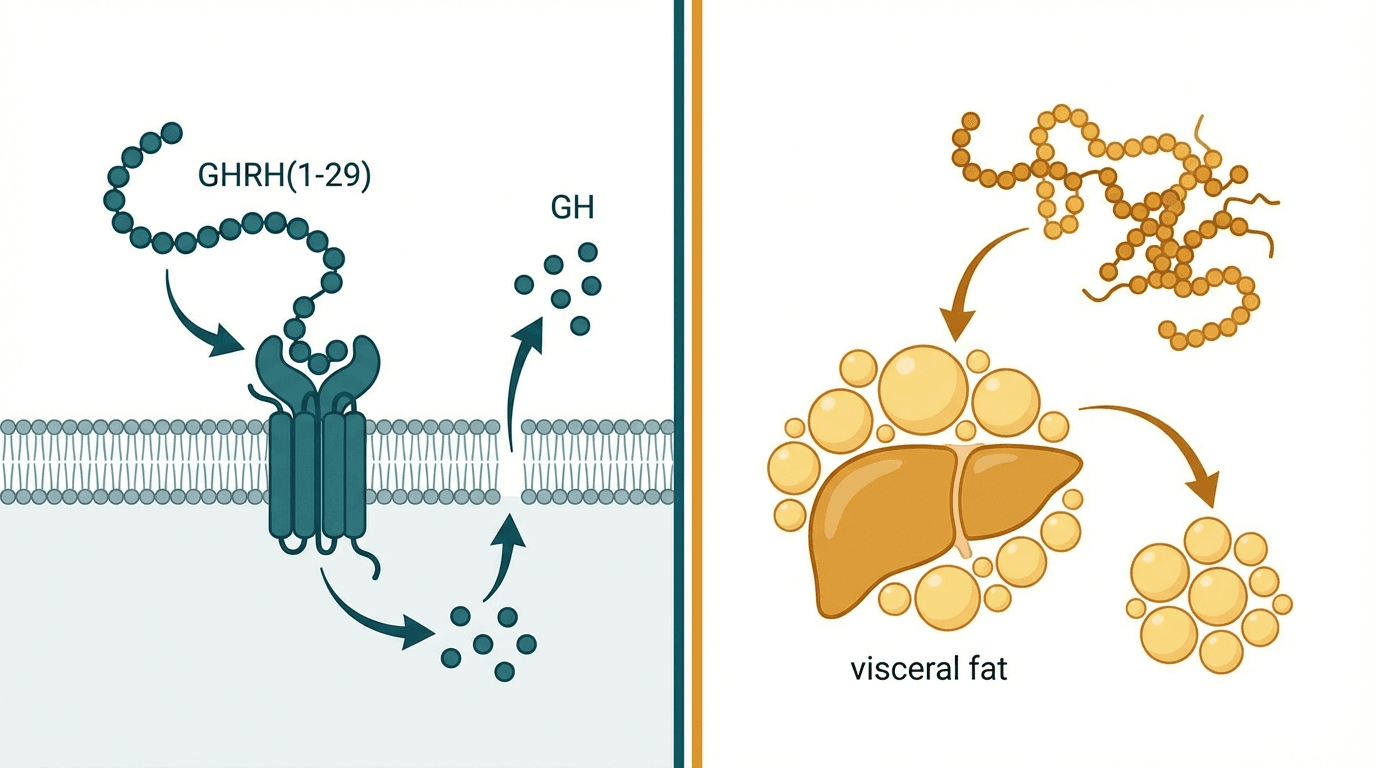
Sermorelin and tesamorelin are both growth hormone releasing hormone (GHRH) analogs that stimulate the pituitary to produce natural GH, but they occupy very different positions in clinical medicine. Tesamorelin (brand name Egrifta) is the only GHRH analog currently FDA-approved — specifically for reducing excess abdominal fat (lipodystrophy) in HIV-infected patients — and has robust clinical trial data demonstrating significant visceral fat reduction. Sermorelin is an older GHRH(1-29) analog with decades of clinical history, formerly FDA-approved for pediatric GH deficiency (brand Geref, now discontinued), and widely used off-label in anti-aging clinics for general GH optimization.
Head-to-Head Comparison
| Criteria | Sermorelin | Tesamorelin |
|---|---|---|
| Primary mechanism | GHRH receptor agonist — bioidentical GHRH(1-29) fragment | GHRH receptor agonist — modified GHRH(1-44) with trans-3-hexenoic acid |
| FDA approval status | Previously FDA-approved (Geref) for pediatric GH deficiency; brand discontinued | Currently FDA-approved (Egrifta/Egrifta SV) for HIV-associated lipodystrophy |
| GH release potency | Moderate GH stimulation — effective but less potent per dose than tesamorelin | More potent GH stimulation — stronger and more consistent GH/IGF-1 elevation in clinical trials |
| Visceral fat reduction | Some evidence for body composition improvement, less specific data | Strong clinical evidence — 15–18% visceral fat reduction in Phase III trials |
| Typical dosage | 200–300 mcg subcutaneous, once daily before bed | 2 mg subcutaneous, once daily (FDA-approved dose) |
| Half-life | ~10–20 minutes | ~26–38 minutes |
| Amino acid sequence | 29 amino acids — the biologically active N-terminal fragment of native GHRH | 44 amino acids — full-length GHRH with a trans-3-hexenoic acid modification |
| Clinical trial data | Moderate — older studies from 1980s–1990s, primarily in pediatric GH deficiency | Extensive — multiple large Phase III trials (>800 patients), published in NEJM and JAMA |
| Cognitive effects | Limited data on cognitive outcomes | Emerging evidence for neuroprotective effects — improved cognition in studies of HIV patients and mild cognitive impairment |
| Side effects | Mild — injection site reactions, facial flushing, headache | Mild to moderate — injection site reactions (erythema, pruritus), arthralgia, peripheral edema |
| Availability | Widely available through compounding pharmacies and anti-aging clinics | Prescription-only (FDA-approved); some compounding pharmacies; significantly more expensive |
| Approximate monthly cost | $50–$100 (compounding); $200–$400 (clinic protocol) | $500–$1,000+ (compounding); $1,500–$3,000+ (brand Egrifta) |
When to Choose Each
Choose Sermorelin
General anti-aging and GH optimization on a budget, patients who want a well-tolerated peptide with long clinical history, those stacking with ipamorelin or GHRP-2 for synergistic GH release
Choose Tesamorelin
Targeted visceral fat reduction, patients with HIV-associated lipodystrophy (FDA-approved indication), those seeking the most clinically validated GHRH therapy, individuals with cognitive decline concerns
Verdict
Tesamorelin is the objectively more potent and better-studied GHRH analog with FDA approval, proven visceral fat reduction, and emerging cognitive benefits — but it comes at a significantly higher cost. Sermorelin is the practical choice for most anti-aging and GH optimization protocols: it is well-tolerated, widely available from compounding pharmacies, affordable, and has decades of clinical use behind it. For patients specifically targeting visceral fat reduction or those who want the strongest evidence-backed GHRH therapy, tesamorelin is worth the premium. For general GH optimization, improved sleep, recovery, and body composition on a budget, sermorelin (often stacked with ipamorelin) remains the most popular option.
References
- Tesamorelin, a human growth hormone releasing factor analogue, reduces visceral fat in HIV-infected patients: a randomized, double-blind, placebo-controlled trial (NEJM) (2007) — PubMed
- Effects of tesamorelin on visceral fat and liver fat in HIV patients with abdominal fat accumulation (2014) — PubMed
- Sermorelin: a review of its use in the diagnosis and treatment of children with idiopathic growth hormone deficiency (1999) — PubMed
- Tesamorelin effects on brain structure and function among HIV-infected patients: a double-blind placebo-controlled study (2017) — PubMed
- Growth hormone-releasing hormone and its analogs: clinical therapeutic utility and mechanism of action (2007) — PubMed
Frequently Asked Questions
Is tesamorelin worth the extra cost over sermorelin?
Can tesamorelin be used for anti-aging like sermorelin?
Do sermorelin and tesamorelin suppress natural GH production?
Can I stack sermorelin or tesamorelin with ipamorelin?
What kind of blood work should I get while using sermorelin or tesamorelin?
Explore next
- Sermorelin dosage guideComplete sermorelin dosage guide with injection protocols, bedtime timing rationale, 5-on/2-off cycling strategy, reconstitution instructions, and stacking considerations. Covers standard and higher dose protocols based on published research and clinical use patterns.
- Tesamorelin dosage guideEducational reference covering tesamorelin dosage protocols, reconstitution instructions, and administration guidelines as discussed in research literature.
- Reconstitution CalculatorCalculate exactly how many units to draw on your syringe. Enter your vial size, bacteriostatic water volume, and desired dose.
- Dosage CalculatorFind evidence-based dosing ranges for any peptide. Adjust for body weight, experience level, and administration route.
- Cost CalculatorEstimate peptide costs per dose, per week, per month, and per year. Enter your vial price and dosing schedule to plan your budget.