Humanin vs MOTS-c
Humanin and MOTS-c are both mitochondrial-derived peptides (MDPs) — small peptides encoded within the mitochondrial genome rather than nuclear DNA — making them unique among bioactive peptides. Humanin is a 24-amino acid cytoprotective peptide that inhibits apoptosis and protects neurons, with primary research applications in Alzheimer's disease, cardiovascular protection, and age-related cellular decline. MOTS-c is a 16-amino acid peptide that functions as an exercise mimetic, activating AMPK to improve insulin sensitivity, enhance metabolic regulation, and promote cellular energy homeostasis. Together they represent two faces of mitochondrial signaling: Humanin protects cells from death, while MOTS-c optimizes cellular energy metabolism.
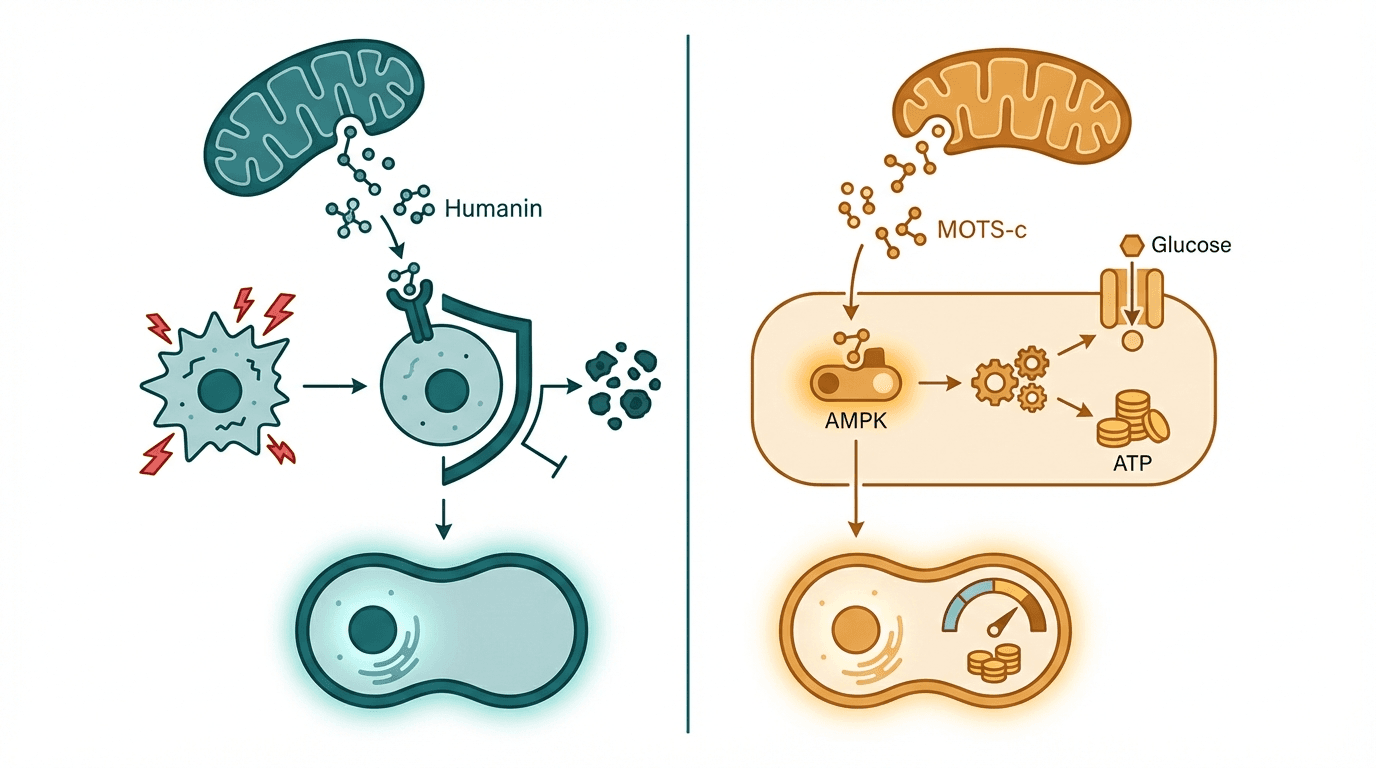
Head-to-Head Comparison
| Criteria | Humanin | MOTS-c |
|---|---|---|
| Primary mechanism | Anti-apoptotic — binds BAX and Bid to prevent mitochondrial membrane permeabilization and cell death | AMPK activation — mimics exercise signaling to enhance glucose uptake and fatty acid oxidation |
| Primary research application | Neuroprotection (Alzheimer's, neurodegeneration), cardiovascular protection, anti-aging | Metabolic regulation (insulin sensitivity, obesity), exercise mimetic, aging metabolism |
| Peptide origin | Encoded in MT-RNR2 gene (mitochondrial 16S rRNA) | Encoded in MT-RNR1 gene (mitochondrial 12S rRNA) |
| Amino acid length | 24 amino acids | 16 amino acids |
| Key signaling pathways | STAT3, IGFBP-3/BAX, TRIM11, FPRL1/FPRL2 receptors | AMPK/SIRT1/PGC-1α, folate-methionine cycle, nuclear translocation |
| Effect on glucose metabolism | Indirect — improves insulin sensitivity via IGFBP-3 signaling and beta-cell protection | Direct — activates AMPK to increase glucose uptake in skeletal muscle, reduces insulin resistance |
| Neuroprotective effects | Strong — protects against amyloid-beta toxicity, tau pathology, and neuronal apoptosis | Emerging — some evidence for cognitive benefits via metabolic optimization and reduced neuroinflammation |
| Cardiovascular effects | Cardioprotective — reduces atherosclerosis, protects cardiomyocytes from ischemia-reperfusion injury | Cardioprotective — improves endothelial function via AMPK activation and metabolic improvement |
| Levels with aging | Decline significantly with age — lower levels associated with Alzheimer's and cardiovascular disease | Decline significantly with age — lower levels associated with metabolic syndrome and sarcopenia |
| Exercise relationship | Not directly exercise-related — constitutively expressed and regulated by stress signals | Exercise mimetic — levels increase with physical activity; MOTS-c translocates to nucleus during exercise |
| Research status | Preclinical — extensive in vitro and animal model data; no human clinical trials completed | Early clinical — first-in-human study completed (2023); preclinical data extensive |
| Route of administration (research) | Intraperitoneal or subcutaneous (animal studies) | Subcutaneous or intraperitoneal (animal and human studies) |
When to Choose Each
Choose Humanin
Neuroprotection, Alzheimer's disease research, anti-apoptotic therapy, cardiovascular protection, age-related cellular decline, longevity research focused on cell survival
Choose MOTS-c
Metabolic syndrome, insulin resistance, exercise mimetic effects, obesity research, aging metabolism, physical performance in aging populations, type 2 diabetes research
Verdict
Humanin and MOTS-c target fundamentally different aspects of cellular health despite both originating from the mitochondrial genome. Humanin is the stronger candidate for neuroprotection and anti-aging at the cellular survival level — its ability to directly block apoptotic pathways makes it particularly relevant for neurodegenerative diseases like Alzheimer's and for cardioprotection. MOTS-c is the more actionable peptide for metabolic health and physical performance — it has progressed further clinically, has a clearer translational path as an exercise mimetic, and addresses the widespread problems of insulin resistance and metabolic syndrome. For longevity-focused protocols, both peptides address complementary aspects of mitochondrial decline with aging.
References
- Humanin: a harbinger of mitochondrial-derived peptides? (2013) — PubMed
- MOTS-c is an exercise-induced mitochondrial-encoded regulator of age-dependent insulin sensitivity (2021) — PubMed
- The mitochondrial-derived peptide MOTS-c: a player in exceptional longevity? (2016) — PubMed
- Humanin prevents age-related cognitive decline in mice and is associated with improved cognitive function in humans (2019) — PubMed
- First-in-human study of MOTS-c demonstrates safety and improved insulin sensitivity in obese adults (2023) — PubMed
- The cytoprotective peptide humanin: structure, function, and therapeutic potential (2018) — PubMed
Frequently Asked Questions
What are mitochondrial-derived peptides (MDPs)?
Can Humanin and MOTS-c be used together?
Has MOTS-c been tested in humans?
Why do Humanin and MOTS-c levels decline with aging?
Are Humanin and MOTS-c available for purchase, and what do they cost?
Explore next
- Reconstitution CalculatorCalculate exactly how many units to draw on your syringe. Enter your vial size, bacteriostatic water volume, and desired dose.
- Dosage CalculatorFind evidence-based dosing ranges for any peptide. Adjust for body weight, experience level, and administration route.
- Cost CalculatorEstimate peptide costs per dose, per week, per month, and per year. Enter your vial price and dosing schedule to plan your budget.